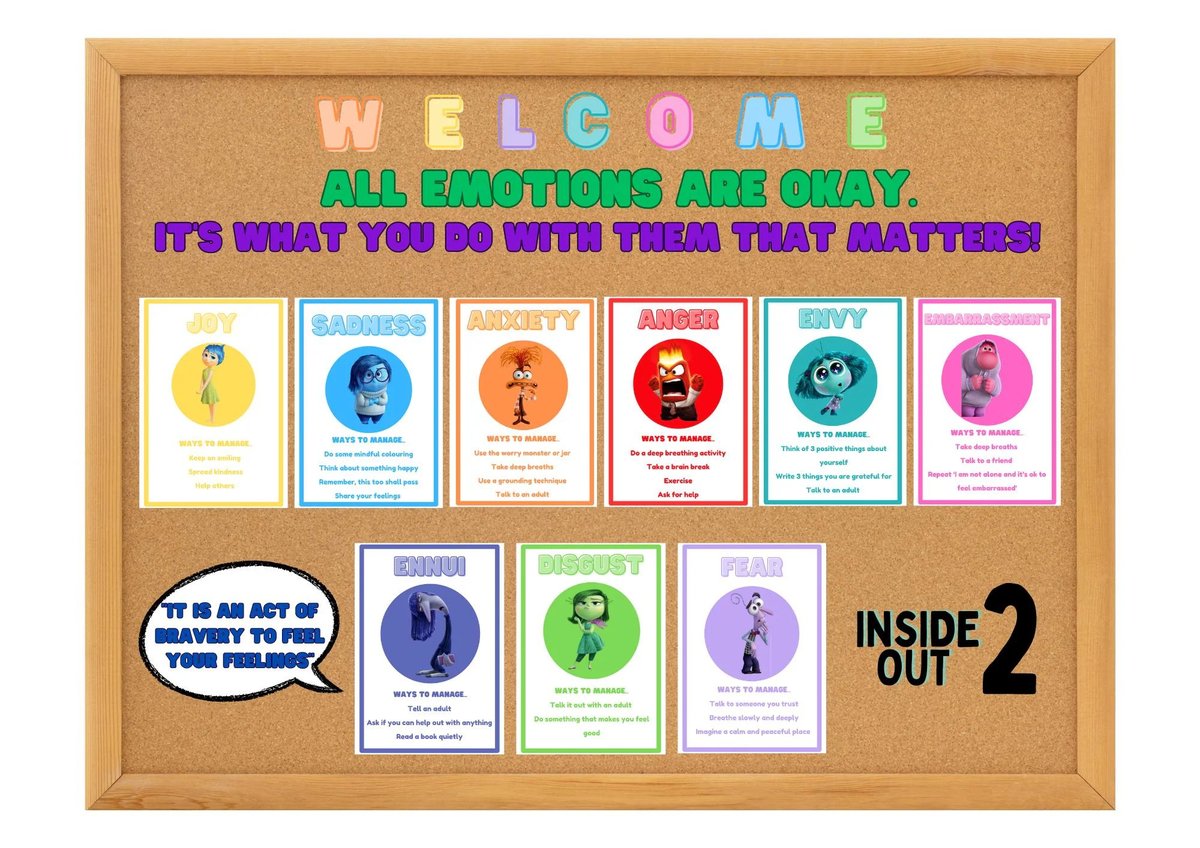
The vibrant, swirling world inside Riley's head has captivated us for years, offering a surprisingly sophisticated language for our own complex emotional landscapes. With the release of Inside Out 2, that internal world just got a whole lot more crowded—and a whole lot more relatable. As we watch Riley navigate the tumultuous waters of adolescence, new emotions like Anxiety, Envy, Embarrassment, and Ennui storm the control panel, demanding attention and reshaping her sense of self. Far from just a delightful animated film, Inside Out 2 is a masterclass in social-emotional learning, providing invaluable coping strategies inspired by Inside Out 2 to understand emotions, manage change, and ultimately, embrace the messy, beautiful totality of who we are.
This isn't just about watching a movie; it's about seeing ourselves reflected on screen and then applying those insights to real life. It’s about understanding why sometimes we feel overwhelmed, why certain anxieties grip us, and how we can learn to work with our inner cast of characters, rather than against them.
At a Glance: Your Inside Out 2 Guide to Emotional Coping
- Embrace Your Whole Emotional Palette: Recognize that growth brings new, complex feelings. Don't fight them; understand what they're trying to tell you.
- Harness Anxiety's Power: Anxiety isn't always the enemy. Learn to channel its energy for preparation and proactive planning, rather than letting it paralyze you.
- Cultivate an Authentic Self: Release the pressure to be perfect. Your true self is a rich tapestry of all your experiences—the good, the bad, and the awkward.
- Teach Your Emotions to Team Up: Your feelings aren't meant to operate in silos. Learn how different emotions can work together, even during tough moments, to bring you back to balance.
- Become a Change-Adaptability Pro: Life is constant evolution. Develop the resilience to adjust to new circumstances, learn from challenges, and maintain your core identity amidst flux.
Why "Inside Out 2" Isn't Just for Kids: A Deeper Look at Emotional Intelligence
Before we dive into specific coping strategies, let's acknowledge why these films resonate so deeply across generations. They take abstract psychological concepts and make them tangible, relatable, and even endearing. Through the personification of emotions, Inside Out and its sequel provide a visual vocabulary for internal experiences that can often feel isolating and confusing.
The films are, at their core, powerful tools for Social Emotional Learning (SEL) and mental health literacy. They help us:
- Define Our Sense of Self: By showing how core memories and evolving emotions shape Riley's "Islands of Personality" and her self-identity, the films offer a metaphor for how our own experiences sculpt who we become. It’s a dynamic, ever-changing process, not a static state.
- Identify Emotional Triggers: Watching Joy, Sadness, Anger, Fear, Disgust, and the new crew take over the "control panel" helps us recognize when certain emotions are in the driver's seat. It gives us a language to name what we're feeling and, importantly, to start recognizing what might have triggered those emotions in ourselves. Is it a looming deadline? A social interaction gone awry? A sense of unfairness?
- Understand Evolving Personality: Inside Out 2 explicitly addresses that personality isn't set in stone. As Riley matures, her internal world expands, bringing a richer, more nuanced emotional experience. This mirrors our own journey, especially through adolescence and into adulthood, where we constantly integrate new feelings and experiences.
- Navigate Social Dynamics: Riley's struggles with peer pressure, fitting in with an older crowd, and even deciphering sarcasm offer a relatable lens through which to view our own social challenges. These scenes underline how deeply our emotions are tied to our interactions with others.
- Demystify Anxiety: The character of Anxiety, with her frantic planning and worst-case scenario projections, offers an incredibly accurate, albeit amplified, depiction of how worry can be both a motivator and an overwhelming force. Understanding her role helps us differentiate between productive foresight and paralyzing panic.
- Learn Positive Choices & Conflict Resolution: Riley's journey is filled with trial and error. We see her make choices driven by intense emotions, experience the consequences, and then learn to adapt and resolve internal (and external) conflicts. This modeling is crucial for developing our own problem-solving skills.
So, how can we translate these cinematic insights into practical, everyday coping strategies? Let's break it down, drawing directly from the powerful mental health lessons woven into Inside Out 2.
Embracing Emotional Complexity & Growth: Welcoming Your Whole Self
One of the most profound takeaways from Inside Out 2 is the acknowledgment that as we grow, especially into adolescence and beyond, our emotional lives become exponentially richer and more complex. The arrival of Anxiety, Envy, Embarrassment, and Ennui isn't a problem; it's a natural part of maturing. This emotional diversity is not something to suppress but to understand and integrate.
The Strategy: Mindful Emotional Inventory
Just as the new emotions burst into Riley's mind, new feelings will inevitably arise in your own life. Instead of immediately judging or pushing them away, pause.
- Name It to Tame It: What is this emotion? Is it a rush of excitement? A pang of disappointment? A low hum of anxiety? Giving a name to what you're feeling is the first step toward understanding it. Inside Out 2 literally gives faces to these feelings, making this step easier for us.
- Ask "What Is This Trying to Tell Me?": Every emotion carries a message. Sadness might signal a need for comfort or processing loss. Anger might point to a boundary crossed or a perceived injustice. Anxiety could be a call to prepare or a sign of overwhelm. Envy might highlight a desire or a value you hold. Don't let the emotion just be; interrogate it kindly. What insight is it offering about your current situation or unmet needs?
- Practice "Emotional Welcome": Imagine each new emotion as a new character showing up in your mind. Instead of kicking them out, acknowledge their presence. "Hello, Anxiety. I see you're here. What's on your mind today?" This act of acceptance, rather than resistance, paradoxically often reduces the intensity of the emotion. It frees up energy you might otherwise spend fighting it.
- Journal Your Emotional Landscape: Keep a simple journal dedicated to your feelings. Jot down what you felt, when, what triggered it, and what you think it was trying to communicate. Over time, you'll start to see patterns and develop a deeper self-understanding, much like Joy started to understand Sadness's vital role.
This approach fosters self-understanding and emotional regulation, helping you navigate the sometimes-turbulent waters of your inner world with more grace and wisdom.
Harnessing Anxiety: Turning Worry into Preparation
Anxiety often gets a bad rap, and for good reason—excessive anxiety can be paralyzing, leading to burnout and inaction. However, Inside Out 2 beautifully illustrates that a healthy dose of anxiety can be incredibly beneficial. Riley's Anxiety character motivates her to prepare for hockey tryouts, consider potential outcomes, and strive for success. The goal isn't to eradicate anxiety entirely, but to manage it effectively and channel its energy for growth.
The Strategy: Productive Anxiety & Structured Worry
Think of Anxiety as a super-planner who sometimes gets carried away. Your job is to give her a task list and a schedule, rather than letting her run wild with "what ifs."
- Channel Anxious Energy into Actionable Steps: When you feel anxiety bubbling up, instead of spiraling, ask: "What can I do about this?" If you're anxious about a presentation, channel that into meticulous preparation. If you're worried about an upcoming bill, channel it into creating a budget. Break down big anxieties into small, manageable tasks. The very act of taking control, even in a small way, can reduce the overwhelming feeling.
- Embrace the "What If... Then What" Game (Strategically): Anxiety's specialty is "what ifs." You can use this to your advantage. If your Anxiety is saying, "What if I fail the exam?" instead of stopping there, continue: "...then what would I do? I would study harder next time, talk to the professor, or explore other options." This pre-emptive problem-solving, without dwelling on the negative outcome, can provide a sense of control and preparedness.
- Schedule "Worry Time": If you find anxiety intruding throughout your day, try scheduling a specific "worry time" (e.g., 15-20 minutes in the late afternoon). When anxious thoughts pop up outside this time, acknowledge them, then politely tell yourself, "I'll address this during my worry time later." During your scheduled slot, give yourself permission to worry freely, brainstorm solutions, or just reflect. Once the time is up, consciously shift your focus.
- Differentiate Between Productive and Unproductive Anxiety: Productive anxiety prompts you to take reasonable precautions or plan ahead. Unproductive anxiety is repetitive, lacks a clear path to action, and simply causes distress. Learn to recognize the difference. If it's unproductive, gently redirect your attention to something controllable or calming.
- Acceptance as a Coping Mechanism: As strange as it sounds, simply accepting anxiety as a natural, albeit uncomfortable, response to uncertainty can take away some of its power. "It's okay to feel anxious right now. This is a normal human emotion." This radical acceptance, without judgment, can actually lower your physiological arousal. For more on navigating this specific emotion, consider exploring our Inside Out 2 anxiety guide.
By practicing these strategies, you can begin to transform anxiety from a debilitating force into a protective and motivating ally, much like Riley eventually learns to do.
Cultivating a Balanced Sense of Self: Beyond Perfection
Riley's journey in Inside Out 2 highlights the adolescent struggle between presenting a "perfect" self to fit in and dwelling on perceived flaws. She tries to suppress her "uncool" core memories, attempting to create a new, flawless identity. The film subtly reveals that her true self is a complex, beautiful mixture of all her experiences—the positive, the negative, the embarrassing, and the joyful. A healthy self-image embraces this entire spectrum.
The Strategy: Authentic Self-Compassion & "Memory Mosaic"
Your personality isn't a fixed, polished marble statue; it's a dynamic, intricate mosaic built from every memory, every emotion, and every choice.
- Challenge the "Highlight Reel" Fallacy: Social media often presents a curated, perfect version of reality, leading us to believe everyone else has it all together. Remind yourself that everyone has their own "uncool" moments, awkward memories, and internal struggles. Resist the urge to constantly present a perfect façade. Authenticity is often far more appealing and sustainable than perfection.
- Practice Self-Compassion, Not Self-Criticism: When you make a mistake or feel embarrassed, instead of harsh self-criticism, treat yourself with the same kindness and understanding you would offer a good friend. Acknowledge your struggle, offer words of comfort, and remind yourself that imperfections are part of being human. Self-compassion allows you to learn from mistakes without being crippled by them.
- Recognize Your "Core Memories" as a Whole: Just like Riley's "Islands of Personality" are built from core memories, your identity is built from your most impactful experiences. Instead of trying to hide or delete the "embarrassing" or "sad" ones, see them as integral parts of your story. They shaped you, taught you lessons, and contributed to your unique perspective. Without Sadness, there is no depth to Joy. Without Embarrassment, there is no humility.
- Identify Your Strengths AND Weaknesses (and Embrace Both): Take time to honestly assess your strengths and areas for growth. Acknowledge what you're good at, what you enjoy, and what makes you unique. Simultaneously, be kind about your weaknesses. They don't make you less worthy; they simply highlight areas for development or acceptance. A balanced self-perception isn't about being universally good; it's about being genuinely you.
By embracing your full spectrum of experiences, you build a robust and resilient sense of self that can withstand the pressures of external judgment and internal criticism.
The Symphony of Emotions: Learning to Work Together
One of the most powerful moments in Inside Out 2 is when Riley experiences a panic attack, and all her emotions—even the new, unfamiliar ones—learn to cooperate to help her calm down. Mental health isn't about maintaining a single, constant emotional state. It's about recognizing that emotions are a team, each with a role, and learning how to utilize them collectively.
The Strategy: Emotional "Check-In" & Collaborative Response
Think of your emotional control panel, not as a place for one emotion to dominate, but as a diverse team meeting where everyone has a voice.
- Perform a Regular Emotional "Check-In": Take moments throughout your day to pause and ask yourself: "What am I feeling right now? What are the prominent emotions?" Use an emotion wheel if helpful to expand your vocabulary beyond "good" or "bad." You might be feeling a mix of apprehension and excitement, or a layer of frustration over underlying sadness.
- Identify the Dominant Emotion's Message: Once you've identified your feelings, give voice to the most prominent one. "Okay, Anger, I hear you. You're feeling frustrated because X happened." Or, "Sadness, I recognize you're here because of Y." Acknowledge its presence and listen to its message.
- Bring in the "Supporting Cast": What other emotions are present? Is there a flicker of hope beneath the anxiety? A sense of purpose alongside the fear? How might these other emotions contribute to understanding or managing the situation? Just as Joy learned to make space for Sadness, you can learn to see how different emotions offer different perspectives and potential solutions.
- Practice "Emotion Stacking" for Coping: When overwhelmed, consciously try to introduce a calming emotion. If you're feeling intense anxiety, can you intentionally call on a memory that brings a sense of comfort or security (Joy)? Can you acknowledge the sadness (Sadness) that might be underlying anger, allowing for a more compassionate response? This is about allowing emotions to blend and influence each other constructively. For instance, sometimes a touch of sadness allows us to process grief, which then makes space for gentle joy.
- Communicate Your Emotional Landscape: Learning to articulate your complex emotional state to others can be incredibly empowering. Instead of saying, "I'm fine," try, "I'm feeling a bit overwhelmed right now, and also a little hopeful about getting through it." This vulnerability can foster deeper connections and help others understand how to support you.
By allowing your emotions to work in concert, rather than letting one take over entirely, you build a more robust system for self-regulation and navigating life's challenges.
Navigating Change with Adaptability: Building Resilience
Change is an inevitable, often uncomfortable, part of life. Inside Out 2 shows Riley grappling with significant life changes—leaving middle school, entering high school, navigating new friendships and social circles. These shifts trigger new emotions and lead to a profound transformation of her Sense of Self. Resilience isn't about resisting change or pretending it doesn't affect you; it's about flexibly adjusting to new circumstances while maintaining a core sense of who you are.
The Strategy: Focused Adaptability & "Growth Mindset" through Change
When the landscape of your life shifts, you can either become rigid and break, or you can become flexible and flow.
- Focus on the Controllables: When faced with big changes, it's easy to feel overwhelmed by everything that's outside your influence. Instead, create a mental (or written) list of what you can control. Can you control your attitude? Your effort? Your routine? Your responses? By focusing energy here, you reclaim agency and reduce feelings of helplessness.
- Set Small, Achievable Goals: Major life changes (like starting a new job, moving, or ending a relationship) can feel like climbing Mount Everest. Break down the overarching challenge into tiny, manageable steps. Celebrate each small victory. This builds momentum and confidence, reminding you that you are capable of adapting.
- Allow for a Mix of Emotions (and Grief): Change, even positive change, often comes with a sense of loss—loss of the familiar, loss of a past identity, loss of old routines. It's okay to feel sad, anxious, excited, and even a little confused all at once. Give yourself permission to mourn what's left behind while also looking forward to what's ahead. This is the integration of emotions at play.
- View Change as a Learning Opportunity: Every transition, every challenge, is an opportunity for growth. What new skills can you learn? What new insights can you gain about yourself? How can this experience strengthen your resilience? Adopting a "growth mindset" transforms obstacles into stepping stones.
- Maintain Core Self-Identity Anchors: While your personality evolves, what are the fundamental values, relationships, or activities that ground you? Cling to these anchors during times of flux. If your core value is creativity, find ways to express it in your new situation. If a certain friend provides stability, lean on that connection. These anchors help you maintain your core sense of self even when everything else feels uncertain.
- Seek Support and Share Your Journey: You don't have to navigate change alone. Lean on friends, family, mentors, or even professional support if needed. Sharing your experiences, fears, and triumphs can provide perspective, comfort, and practical advice.
Embracing adaptability means viewing life as an ongoing process of learning and evolving, much like Riley's personality islands are continually being rebuilt and reconnected.
Common Questions & Misconceptions About Emotional Coping
It's natural to have questions when you start exploring the intricate world of your emotions. Let's tackle a few common ones, inspired by the nuances of Inside Out 2.
"Is it bad to feel the 'new' emotions like Anxiety or Envy?"
Absolutely not. Inside Out 2 makes it clear that these emotions are a natural, even necessary, part of growing up. Anxiety can protect you and push you to prepare. Envy, while uncomfortable, can highlight your own desires and values, motivating you toward your goals. Embarrassment helps you learn social boundaries. Ennui can signal a need for new stimulation or deeper meaning. The key isn't to eliminate them, but to understand their messages and manage their intensity so they don't dominate your control panel.
"How can I make my emotions 'work together' when they feel like they're fighting?"
Think of it less as forcing cooperation and more as fostering communication. When emotions clash, it often means there are conflicting needs. For example, your Anger might want to lash out, but your Sadness might want comfort, and your Fear might want safety. The strategy here is to acknowledge all voices. Ask each emotion what it needs. Then, see if there's a way to meet those needs creatively, rather than letting one emotion silence the others. It's about integration, not suppression.
"Isn't avoiding uncomfortable emotions easier?"
In the short term, yes, avoidance can feel like a quick fix. However, Inside Out 2 shows us the danger of this. When Riley tries to suppress her "uncool" memories or emotions, it doesn't make them disappear; it simply makes them stronger or leads to emotional outbursts and deeper internal conflict. Avoiding emotions prevents you from learning their messages, processing experiences, and developing true resilience. It's like sweeping dirt under the rug—eventually, you'll trip over it. Engaging with discomfort, even briefly, leads to lasting growth.
"What if my 'Joy' feels like it's never in control anymore?"
It's common, especially during challenging times or periods of significant change, for other emotions to take the lead. Inside Out 2 shows Joy being "bottled up" and having to fight her way back to the control panel. This is a metaphor for real life. If Joy feels absent, it might be a sign that other emotions (like Sadness or Anxiety) need attention and processing first. Once those emotions have been acknowledged and their messages understood, Joy often finds her way back, often richer and deeper because she's integrated the wisdom of the other emotions. Actively seek out small moments of pleasure and connection to nurture Joy, even when she's not at the forefront.
Your Emotional Journey Begins (or Continues) Now
The genius of Inside Out 2 isn't just in its dazzling animation or heartwarming story; it's in its profound ability to normalize the complexities of our inner lives. It reminds us that our emotional worlds are dynamic, messy, and constantly evolving—and that's perfectly okay.
These coping strategies, inspired by Riley's journey, aren't about achieving perfect emotional control. They're about fostering a deeper understanding of yourself, building resilience in the face of change, and learning to welcome every part of your emotional landscape. By mindfully engaging with your feelings, channeling anxious energy, embracing your authentic self, allowing your emotions to collaborate, and adapting to life's inevitable shifts, you equip yourself to navigate the world with greater wisdom and compassion.
So, the next time a new, overwhelming, or uncomfortable emotion arrives at your internal control panel, don't panic. Take a breath. Listen. And remember the valuable lessons from Inside Out 2: every emotion has a purpose, and by learning to work with them, you unlock a fuller, more authentic, and ultimately, more joyful version of yourself. Your emotional journey is a lifelong adventure, and you're now better equipped than ever to embark on it.